
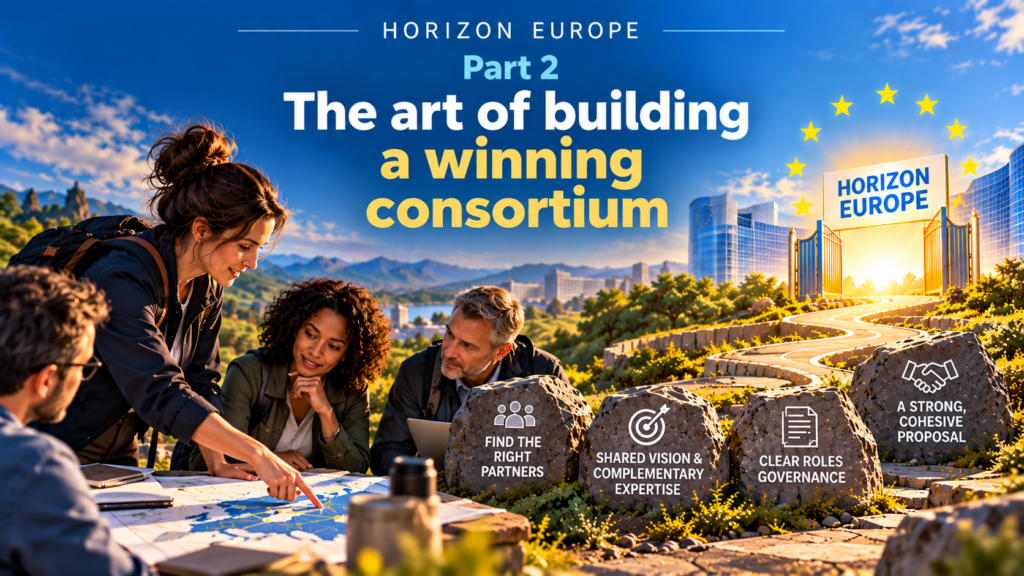
A strong consortium is about far more than assembling impressive names. The right partners bring complementary expertise, credible roles and the collective capability to deliver what the call is asking for. There is something quite magical about the synergistic combination of the right people, in the right place, at just the right time.
Previously, I wrote about one of the biggest myths in Horizon Europe: that excellent research alone is enough to secure funding. This time, I’d like to tackle another common misconception.
Myth: “The bigger the consortium, the stronger the proposal.”
Not necessarily.
Over the years, I’ve seen relatively small consortia secure funding against much larger partnerships because every team or person had a clear purpose and made a meaningful contribution.
A winning consortium isn’t about the number of partners around the table.
It’s about bringing together the right partners, with the right expertise, at the right time.
Every organisation should strengthen the proposal in a way that another partner cannot.
When evaluators look at a consortium, they’re asking questions such as:
 Does the partnership have all the expertise needed to deliver the project?
Are the organisations genuinely complementary?
Is there an appropriate balance between universities, research organisations, businesses, SMEs, public bodies and end users?
Does every partner have a clearly defined role and the capability to deliver it?
Is the consortium credible enough to achieve the project’s ambitions?
One of the biggest mistakes I see is building a consortium around existing relationships rather than project needs.
Of course, trust matters. Long-standing collaborations often make excellent partnerships.
But every organisation should be able to answer one important question:
“Why are we essential to this project?”
If the answer isn’t immediately obvious, evaluators are likely to ask exactly the same question.
A lesson from experience:
One consortium I supported looked strong on paper. Every partner was respected in their field, the science was excellent and everyone had collaborated before.
However, as we started to map the project against the expected outcomes of the call, it became clear that one critical perspective was missing: the organisation that would ultimately help translate the research into real-world adoption.
By bringing in an additional partner with direct access to end users and practical implementation experience, the whole proposal became stronger. It wasn’t about increasing the size of the consortium—it was about strengthening its credibility, impact and pathway to implementation.
Sometimes, the most valuable partner isn’t the one with the biggest research profile. It’s the one that completes the story.
The strongest consortia don’t simply satisfy the eligibility rules.
They create European Added Value by combining expertise, facilities, data, networks and perspectives that no single organisation—or country—could bring together on its own.
Perhaps most importantly, successful consortia don’t appear overnight.
The relationships behind them are often built months or even years before a funding call opens—through previous collaborations, conferences, brokerage events and trusted introductions. That’s one of the reasons I enjoy this stage of Horizon Europe so much. Helping organisations identify missing capabilities, introducing potential partners, and facilitating consortium-building workshops can often make a greater difference to a proposal than any amount of editing later on. The strongest collaborations are built before the writing begins.
 Horizon Tip
Don’t start by asking:
“Who do we know?”
Start by asking:
“What expertise, capability and influence does this project need to succeed?”
Then find the partners who genuinely fill those gaps.
 What is your perspective?
What do you think makes a successful Horizon Europe consortium? Is it experience, diversity, complementary expertise, trusted relationships—or something else?
 Share your thoughts in the comments.
If your organisation is beginning to build a consortium for an upcoming Horizon Europe or collaborative funding call, Tytherleigh Consulting would be happy to discuss how strategic partner identification and facilitated consortium development can help create a stronger foundation for a competitive proposal.