
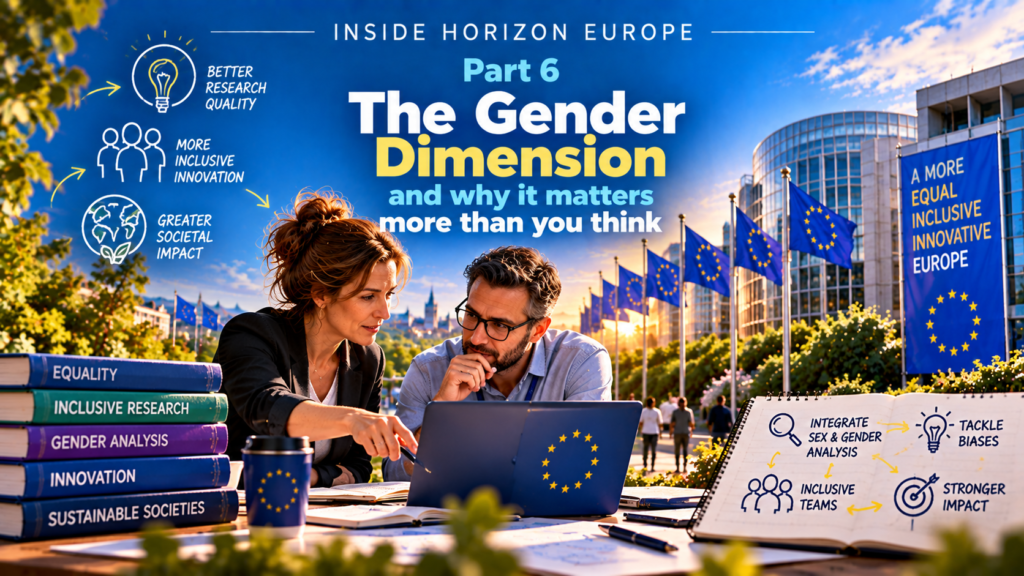
In Horizon Europe, the gender dimension isn’t just about who is on your project team. It’s about whether sex and gender could influence your research, your innovation — and ultimately, the impact you create.
In recent posts, I have explored why great ideas don’t always get funded, how to build stronger consortia, what Excellence really means for Horizon Europe evaluators and why Impact should shape a project from the very beginning. Now I want to explore one of the most misunderstood aspects of Horizon Europe proposals:
The Gender Dimension
Myth 1 : “The gender dimension is simply about achieving gender balance in the project team.”
No – it is much broader than that.
Gender balance within research teams is important, but the gender dimension in Horizon Europe is primarily about understanding whether sex and/or gender could influence the research itself, the innovation being developed, or the way outcomes are delivered and used.
The key question is:
“Could considering sex, gender or diversity improve the quality, relevance or impact of this project?”
If the answer is yes, then this should be reflected throughout the project design.
Why does this matter?
Research and innovation do not happen in isolation.
People experience technologies, services, environments and interventions differently depending on their circumstances, biology, social context and lived experience.
If these differences are not considered, there is a risk that solutions are developed based on incomplete assumptions.
Examples include:
- Medical research where biological differences can influence diagnosis, treatment and outcomes.
- Artificial intelligence systems where biased datasets can reinforce existing inequalities.
- Transport planning where travel patterns and safety concerns may differ between groups.
- Engineering and product design where assumptions about the “average user” may exclude significant parts of society.
- Health and social interventions where barriers to access can determine who benefits from innovation.
Considering gender does not mean changing the research question unnecessarily. It means ensuring the research question is the right one.
Myth: “If gender is not relevant to our project, we can simply say it is not applicable.”
Sometimes gender will genuinely not be relevant.
However, Horizon Europe evaluators expect applicants to demonstrate that they have considered this properly.
A strong proposal explains:
✔️ Why gender is relevant or not relevant.
✔️ What analysis has been undertaken.
✔️ How this has influenced the methodology, data collection, implementation or impact pathway.
A thoughtful justification is far stronger than a generic statement.
A lesson from experience
This is an area where I have gained significant practical experience throughout my career.
At the University of Exeter, I was a DICE Champion, served on the Equality, Diversity and Inclusion Board, and supported the delivery of Horizon Europe gender equality requirements within the institution.
One of the most important lessons I learned is that the gender dimension is not about adding another section to a proposal at the end.
It can fundamentally influence how a project is designed and delivered.
A good example was a research project I supported focused on developing solutions for communities affected by the long-term health impacts of the Bhopal disaster, including people experiencing sight loss.
The research idea itself was compelling.
The scientific challenge was clear, and the potential benefits for affected communities were significant.
However, when we looked more closely at how the solution would be delivered, an important issue emerged.
In the local context, men were more likely than women to have access to sight-saving surgery.
If the project focused only on developing the scientific solution, there was a risk that the benefits would not reach all members of the community equally.
The proposal therefore needed to go beyond the research question.
It needed to consider:
✔️ Who would be able to access the intervention.
✔️ What barriers might prevent different groups benefiting.
✔️ How delivery mechanisms could ensure equitable access.
✔️ How the project would measure whether the intended impact was reaching the whole community.
The science did not change.
The ambition did not change.
But the project became stronger because it considered the realities of implementation.
That is exactly why the gender dimension matters in Horizon Europe.
It is not simply about representation.
It is about ensuring that the research, technologies and solutions we develop are relevant, accessible and effective for the people they are intended to serve.
Gender Equality Plans: More than a compliance requirement
For many Horizon Europe applicants, institutional Gender Equality Plans (GEPs) are now an important requirement.
However, a good GEP is not simply a document created to satisfy a funding condition.
It should demonstrate meaningful organisational commitment to:
✔️ Equality in recruitment and career progression.
✔️ Representation in decision-making.
✔️ Inclusive organisational cultures.
✔️ Identifying and addressing barriers.
✔️ Integrating the gender dimension into research and innovation where relevant.
The strongest organisations recognise that equality, diversity and inclusion are not separate from excellence.
They are part of creating better research and better outcomes.
Why evaluators care
Ultimately, Horizon Europe is investing public funding to address complex challenges.
Evaluators are asking:
“Has this consortium designed the best possible approach to create meaningful outcomes?”
Considering gender and diversity can strengthen:
- Research quality.
- Innovation relevance.
- User engagement.
- Societal acceptance.
- Long-term impact.
It is not simply about compliance. It is about excellence.
💡 Horizon Tip
Don’t ask:
“Do we need to include gender in our proposal?”
Ask:
“Could considering sex, gender or diversity improve the quality, relevance or impact of our research?”
That is the question Horizon Europe evaluators are looking for.
💬 What is your perspective?
Have you found the gender dimension straightforward to address in Horizon Europe proposals, or is it an area where applicants still need more guidance?
👇 Share your experiences below.