
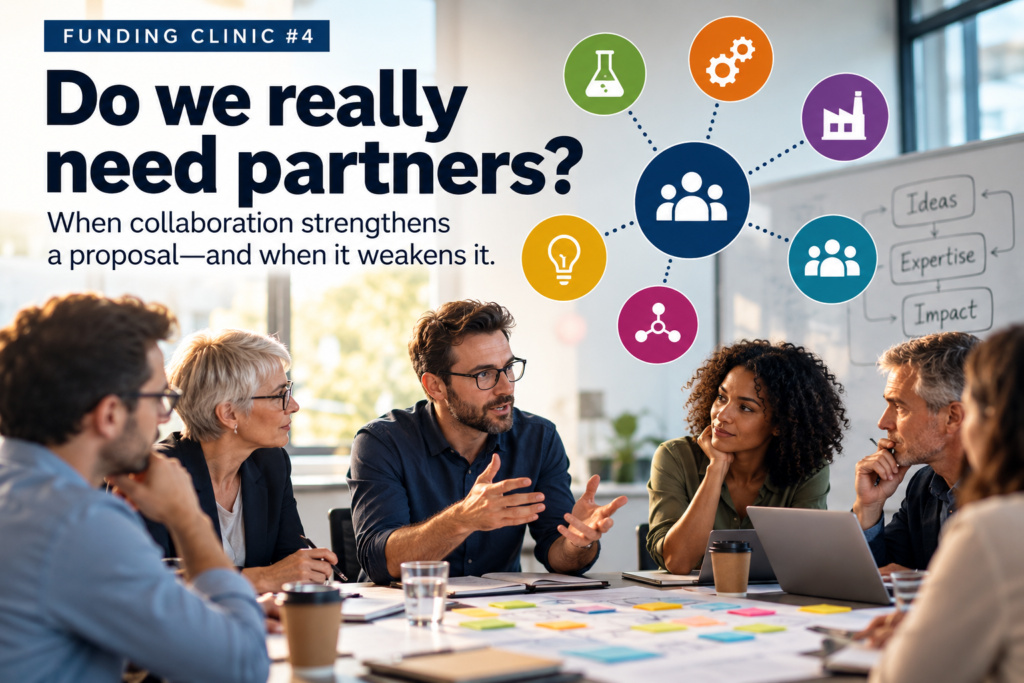
When collaboration strengthens a proposal—and when it weakens it.
“We need a partner.”
It’s something I hear surprisingly often when organisations start thinking about a funding application.
But my first question is usually:
Why?
Sometimes collaboration is essential. The funding call may require it, or the project genuinely needs expertise, facilities, data, access to customers, test environments or routes to market that one organisation cannot provide alone.
But sometimes partners are added because it feels as though a collaborative bid ought to have them.
And that can actually make a proposal weaker.
A good partner should have a job to do
The strongest collaborations are built around the needs of the project.
Each partner should bring something identifiable that helps the project succeed. That might be specialist expertise, facilities, access to users or customers, manufacturing capability, complementary technology, a test environment, market knowledge or a route to adoption.
If you cannot clearly explain why that organisation needs to be involved, it is worth questioning whether they should be a partner at all.
Build the programme together
Some of the most productive consortium-building exercises I have been involved with started well before anyone began writing the application.
I used to facilitate workshops bringing potential partners together to explore an idea and begin shaping it into a research programme.
Those sessions were rarely about everyone arriving with a perfectly defined role. They were about putting the right people in the room and working through some fundamental questions:
- What problem are we actually trying to solve?
- What do we already know?
- Where are the gaps?
- What expertise and capability do we need?
- How might the different elements fit together?
- Who is best placed to lead each part?
- And, importantly, who doesn’t need to be involved?
That process could change the original idea considerably.
One partner might identify a challenge nobody had considered. Another might bring a capability that opened up an entirely new strand of work. Sometimes two proposed activities turned out to overlap. Sometimes an organisation we initially thought was essential wasn’t.
That is what good collaboration should do.
The partners should help shape the programme—not simply populate the consortium.
Bigger isn’t necessarily better
I have also experienced the other end of the spectrum: managing large collaborative projects with simply too many partners.
On paper, a large consortium can look impressive. In practice, it can become unwieldy.
Every additional organisation introduces another relationship to manage, another set of expectations, another contract, another reporting line and potentially another dependency.
But there is another issue that is sometimes overlooked:
the funding gets diluted too.
A substantial award can suddenly look much less substantial when it is divided between a large number of organisations. If too many partners are competing for relatively small pieces of the budget, you can end up with organisations that do not have enough resource to make a meaningful contribution.
The project can become harder to coordinate at exactly the same time as individual partners become less able to deliver.
I’ve seen first-hand how too many partners can dilute both the effectiveness of the collaboration and the funding available to do the work.
So the question shouldn’t be:
“How many partners can we bring in?”
It should be:
“What is the smallest, strongest group of organisations we need to deliver this successfully?”
Start with the gaps, not the names
Before approaching potential partners, map what the project actually needs.
What can you already do yourselves?
What capability, expertise, evidence or access is missing?
Who needs to be involved for the project to succeed?
Who needs to be involved for the resulting research or innovation to be adopted, scaled or commercialised?
Only then start thinking about organisations.
This avoids a common problem: building a consortium around people you know and then trying to invent a work package—or a slice of budget—for everyone afterwards.
Partner, subcontractor or stakeholder?
Not everyone who contributes needs to become a formal project partner.
Sometimes you need a specific service or piece of expertise rather than a collaborator. That may be better provided through subcontracting.
Sometimes you need input from users, customers, local authorities, clinicians, community groups or industry representatives. They might be better involved through an advisory group, pilot, test site or stakeholder panel.
And sometimes you simply need to consult someone at the right stage.
Giving everybody a place in the consortium isn’t necessarily the best way to involve them.
And don’t add a big name just for the logo
A well-known university, multinational company or prestigious organisation can look attractive on a consortium slide.
But a recognisable logo adds little if the organisation has a token role, minimal resource and no meaningful involvement in delivery.
A smaller organisation with exactly the right capability, access or market knowledge can be far more valuable.
Relevance beats prestige.
A simple test
For every proposed partner, try completing this sentence:
“Without this partner, the project would struggle to ______ because ______.”
If the answer is clear and compelling, you probably have a good reason for involving them.
If you’re struggling to fill in the blanks, think again.
Good collaboration isn’t about assembling the biggest consortium.
It’s about bringing together the right capability around a shared problem, giving each partner a meaningful role and enough resource to deliver it.
Sometimes collaboration transforms an idea into something none of the organisations could have achieved independently.
And sometimes the strongest consortium is considerably smaller than you first imagined.
Building a collaborative project?
At Tytherleigh Consulting, consortium building is part of what we do.
We can help identify the capabilities a project needs, find and engage potential partners, and facilitate early-stage discussions and workshops to turn different ideas and expertise into a coherent programme.
And because building the consortium is only the beginning, we can also help develop the funding application and put the structures in place to make the collaboration deliverable.
If you’re developing an idea and wondering who really needs to be around the table, get in touch.