
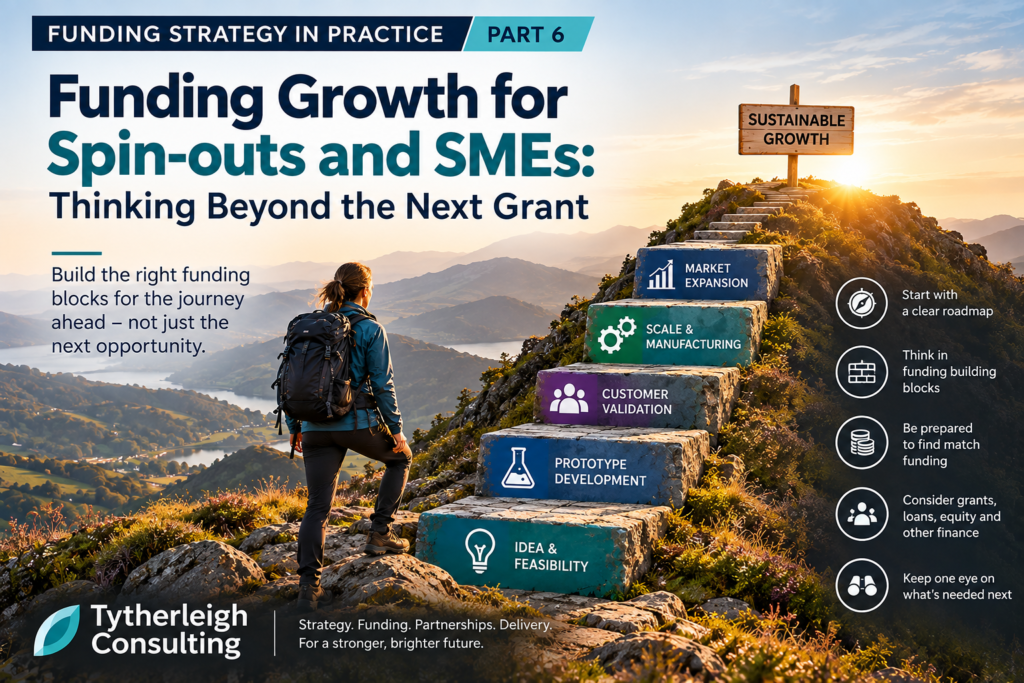
One of the biggest mistakes a spin-out or SME can make is looking for “the funding”.
Because there probably isn’t one pot of money that will take an innovation from where it is today all the way to a sustainable, growing business.
In reality, business growth is usually much more fragmented than that.
You might secure funding to develop the technology.
Then need something else to build a prototype.
Then finance to test it with customers.
Then investment to scale manufacturing.
Then funding to enter a new market.
Meanwhile, of course, you still have a business to run.
So for spin-outs and SMEs, the funding strategy needs to be carefully crafted.
Start with where you’re going
Before searching for funding, map out the journey.
Where is the business now?
Where do you want it to be in 12, 24 or 36 months?
What are the major barriers between here and there?
And what needs to happen – technically, commercially, operationally and financially – to overcome them?
Then break that journey into strategic steps.
Some might require external funding. Others might be funded through revenue, investment, internal resources or partnerships.
The important thing is that the funding supports the strategy – rather than the availability of funding determining the strategy.
Think in building blocks
There is unlikely to be one funding award that does everything.
Instead, you may need to assemble a series of funding building blocks around the development of the business.
One award might help you demonstrate technical feasibility.
Another might enable a university collaboration or access to specialist facilities.
Another could support customer trials or market validation.
Investment might then provide the capital to manufacture, recruit or scale.
The challenge is not simply finding a grant.
It is understanding which building block you need next – while keeping one eye on what comes after it.
Because while you’re delivering today’s funded project, you may already need to be developing the partnership, evidence or application that will fund tomorrow’s growth.
Be prepared to fund the funding
There is also very rarely such a thing as completely free money.
A grant may fund only a percentage of eligible project costs.
If you’re awarded £300,000 towards a £500,000 project, where is the remaining £200,000 coming from?
And can the business genuinely afford it?
Other funding mechanisms bring different questions.
If it’s a loan, can the business service the debt and interest?
If it’s equity, how much of the company are you prepared to give away – and is this the right stage to dilute your ownership?
And whatever the funding mechanism, what commitments come with it?
Milestones. KPIs. Claims. Evidence. Reporting. Governance. Financial records. Audits. Project management.
Winning the money is only the beginning.
You need the capacity to deliver what you’ve promised.
Don’t forget the commercial case
A technically excellent innovation isn’t automatically a viable business.
Who will buy it?
What problem are you solving?
What alternatives already exist?
Why would someone switch?
What evidence do you have that customers actually want it?
And crucially:
What will this particular piece of funding allow you to prove that you cannot prove today?
That could be technical performance.
Customer demand.
Manufacturability.
Regulatory readiness.
Commercial viability.
Or your ability to scale.
Each successful step should ideally make the business more investable, more fundable, more commercially credible – or preferably all three.
And this is where funding becomes a management challenge
For founders and small management teams, there is another problem.
All of this takes time.
Scanning funding opportunities.
Working out whether they are genuinely a good fit.
Developing partnerships.
Preparing applications.
Building budgets.
Negotiating agreements.
Managing funded projects.
Monitoring expenditure.
Producing evidence.
Reporting against milestones and KPIs.
And, at the same time, looking ahead for the next piece of the funding jigsaw.
It can become a significant distraction from actually running and growing the business.
And that’s where I come in.
At Tytherleigh Consulting, I can help businesses build that funding journey: understanding where you are trying to get to, breaking the journey into strategic steps, scanning the horizon for the right funding for those steps and developing the applications, partnerships and projects needed to make them happen.
And once funding is secured, I can help with the negotiation, set-up, management and reporting that follows.
Because a good funding strategy is not just about finding the biggest grant available.
It’s about knowing:
Where are we going?
What do we need to achieve next?
What is the right funding to help us do it?
And what needs to be lined up now to keep the business moving when this funding runs out?
Funding should provide the fuel for growth.
But you still need to know where you are going.