
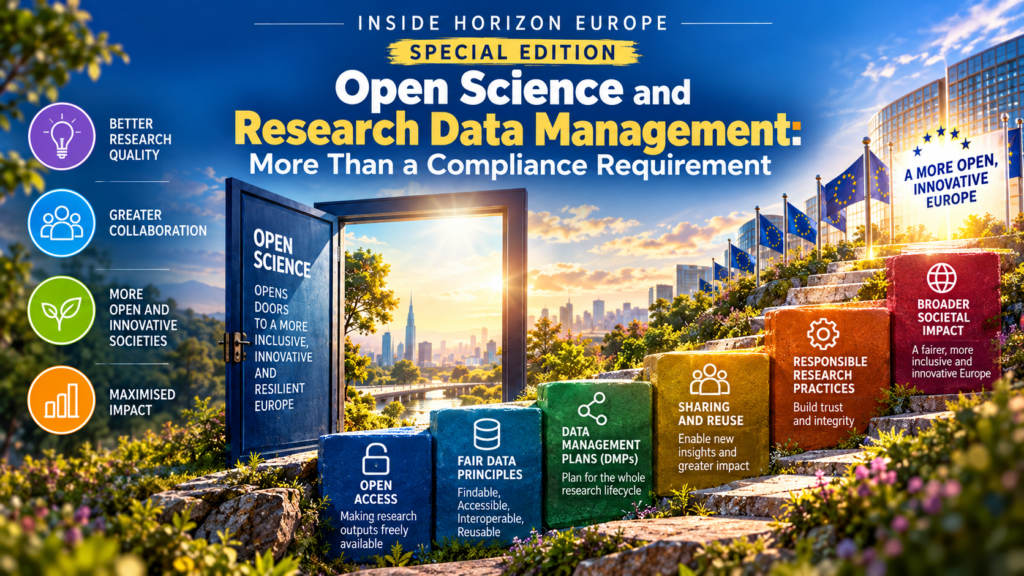
Good research generates knowledge. Great research makes that knowledge accessible, reusable and capable of creating impact far beyond the original project.
Open Science is one of the fundamental principles underpinning Horizon Europe. Yet, for many applicants, it remains something addressed towards the end of proposal development, often alongside ethics, dissemination and other requirements that need to be satisfied before submission.
That is a missed opportunity.
Open Science and Research Data Management (RDM) are not simply administrative obligations. When approached strategically, they can strengthen research quality, improve collaboration, support innovation and significantly extend the value and impact of publicly funded research.
And, importantly, they need to be considered from the very beginning of a project.
What do we actually mean by Open Science?
Open Science is about making the research process, its methods and its outputs more transparent, accessible and reusable.
It goes well beyond publishing academic papers in open-access journals.
Depending on the nature of the research, it can include:
- Open access to publications: ensuring research findings are accessible without subscription barriers.
- Research data sharing: making datasets available for verification, further analysis and reuse wherever appropriate.
- Open methodologies and protocols: enabling other researchers to understand, replicate and build upon research.
- Open-source software: sharing code and tools where appropriate to support wider use and development.
- Citizen and stakeholder engagement: involving relevant communities in shaping, conducting and benefiting from research.
- Reproducibility and transparency: ensuring that research processes and findings can be scrutinised and validated.
These practices contribute to a research environment in which knowledge can circulate more effectively between universities, businesses, policymakers and society.
For Horizon Europe, this is particularly important. The programme is designed not only to fund excellent research but also to ensure that research delivers meaningful scientific, economic and societal benefits.
Research Data Management: planning for value, not simply storage
Research Data Management is closely connected to Open Science, but the two are not interchangeable.
RDM concerns how research data are collected, organised, documented, stored, protected, shared, preserved and, where appropriate, disposed of throughout the research lifecycle.
One of the central concepts is the FAIR principles.
F – Findable: Data should be discoverable, with appropriate descriptions, identifiers and metadata.
A – Accessible: Data should be retrievable through clearly defined access arrangements, which may include restrictions.
I – Interoperable: Data should use appropriate standards and formats to support exchange and integration.
R – Reusable: Data should be sufficiently documented and appropriately licensed to enable future use.
Importantly, FAIR does not automatically mean open.
A dataset can be FAIR while access remains restricted for legitimate reasons, including commercial confidentiality, intellectual property, personal data protection or security.
This distinction matters enormously, particularly in collaborative research involving industry partners.
The objective is not to make everything publicly available regardless of the consequences. It is to manage research outputs responsibly so that they deliver the greatest possible value.
What does Horizon Europe actually require?
Horizon Europe incorporates Open Science practices into both proposal evaluation and project implementation.
Applicants need to demonstrate how appropriate Open Science practices will be embedded within their research methodology. This forms part of the assessment of Excellence.
During implementation, beneficiaries are generally required to:
- Provide immediate open access to peer-reviewed scientific publications arising from the project, in accordance with the grant agreement.
- Manage research data responsibly and in line with the FAIR principles.
- Prepare and maintain a Data Management Plan (DMP), normally with an initial version due within the first six months.
- Deposit research data in trusted repositories and provide open access where required, subject to legitimate exceptions.
- Provide information about the tools, methods and other outputs needed to validate published research conclusions, subject to applicable safeguards.
There may also be additional Open Science obligations or opportunities associated with particular calls.
The guiding principle for research data is:
As open as possible, as closed as necessary.
This recognises that openness must be balanced with legitimate considerations around confidentiality, exploitation, data protection and intellectual property.
The important point is that these decisions should be considered, documented and justified rather than left until the point at which data are ready for publication.
Why this becomes particularly challenging in collaborative projects
One of the most interesting aspects of Horizon Europe is the diversity of organisations that can be brought together within a single consortium.
Universities, research institutes, SMEs, large businesses, public authorities and civil society organisations may all be working towards a common research objective.
But they do not necessarily approach data in the same way.
An academic partner may be focused on publication and advancing scientific knowledge.
An SME may be developing commercially valuable technology, with research data contributing directly to its competitive advantage.
A public sector organisation may be concerned with transparency, accountability and the practical application of research findings.
And another partner may be working with sensitive personal or commercially confidential information.
These are not necessarily conflicting objectives, but they do require careful management.
In my experience of developing and managing large collaborative research programmes, some of the most important discussions happen long before a project begins.
Who owns the background knowledge being brought into the project? Who will own the results? What information can be shared? Who needs access to which datasets? How will publication and commercial exploitation be balanced?
These questions are closely connected to consortium agreements, intellectual property arrangements, exploitation strategies and project governance.
Getting them right early can prevent significant difficulties later.
And this is where good Research Data Management becomes much more than a technical exercise.
It becomes part of the strategic management of the collaboration itself.
A Data Management Plan should be a living document
A DMP is sometimes treated as another deliverable to be completed, submitted and then largely forgotten.
But a good DMP should evolve alongside the research.
It should help the consortium consider:
What data will we generate? Not just experimental datasets, but potentially software, models, images, survey results, technical documentation and other research outputs.
How will we manage them? Including data formats, metadata, quality assurance, secure storage and access permissions.
Who is responsible? Particularly important when different partners generate, process or analyse the same datasets.
What can be shared? Taking account of confidentiality, intellectual property, ethics and legal obligations.
Where will the data go? Identifying suitable repositories, preservation arrangements and the resources needed to maintain access.
What happens after the project ends? Ensuring valuable research outputs are not lost when funding finishes or project teams disperse.
These are practical management decisions with real implications for budgets, responsibilities, infrastructure and the long-term value of the research.
A DMP should therefore be integrated with the project’s wider management, dissemination and exploitation activities.
Open Science and commercialisation are not mutually exclusive
This is an area where I think greater understanding is particularly valuable.
For organisations developing new technologies, products or services, Open Science can sometimes appear to conflict with commercialisation.
Why invest in developing something innovative if the resulting knowledge must then be made freely available?
But the relationship is more nuanced.
Effective research and innovation management involves understanding which outputs should be openly disseminated, which require protection, and how both can contribute to the overall impact strategy.
Publishing scientific findings does not necessarily require disclosing commercially sensitive know-how or surrendering intellectual property rights.
Equally, protecting a commercially valuable result does not mean that every aspect of the underlying research must remain confidential.
A well-designed dissemination and exploitation strategy should identify these distinctions and establish appropriate processes for managing them.
In some cases, open data and open methodologies can actually accelerate commercial opportunities by encouraging wider adoption, strengthening confidence in results, enabling complementary innovation and building new collaborations.
The key is to make deliberate, informed decisions rather than treating openness and commercialisation as competing objectives.
Open Science can strengthen your proposal
There is also a practical funding consideration.
Open Science should not be confined to a generic paragraph promising open-access publications and a Data Management Plan.
It should be reflected in the proposed research methodology.
For example:
- Could sharing methods or datasets improve the reliability and reproducibility of the research?
- Could access to existing datasets avoid unnecessary duplication and strengthen the proposed approach?
- Could open tools or protocols enable other researchers or organisations to build upon the results?
- Could appropriate stakeholder involvement improve the relevance and quality of the research?
- Could a clear approach to data stewardship strengthen confidence in the consortium’s ability to deliver?
These considerations can help demonstrate that the consortium has thought carefully about research quality, collaboration and the future use of its outputs.
They can also reinforce the credibility of the project’s impact pathway.
However, Open Science is not a substitute for a strong impact strategy. Making research available does not automatically mean that someone will use it.
The consortium still needs to understand who might benefit from the outputs, why they would be interested and what needs to happen to support uptake.
My advice: start the conversation early
For anyone preparing a Horizon Europe proposal, I would encourage three things.
First, integrate Open Science into the research design. Think about how appropriate open practices can improve the quality and value of the work, rather than simply how to satisfy the requirements.
Second, involve the right people early. Researchers, data specialists, research support teams, commercialisation professionals and industry partners may all have important perspectives on how research outputs should be managed.
Third, connect data management with the wider project strategy. Your DMP, consortium agreement, intellectual property arrangements, dissemination activities and exploitation strategy should complement one another.
The strongest proposals are not necessarily those that promise to share the most data.
They are those that demonstrate a clear, credible and responsible approach to generating, managing, protecting and using research knowledge.
The bigger picture
Horizon Europe is ultimately about creating knowledge and turning that knowledge into meaningful benefits.
Open Science contributes to that ambition by helping research become more transparent, collaborative, reproducible and reusable.
Research Data Management provides much of the practical foundation needed to make that possible.
Together, they can help ensure that the value of a research project continues long after its final report has been submitted.
The real question is not simply whether your project complies with Open Science requirements. It is whether you are making the most of the knowledge your project will create.
Weblinks:
The most useful official references access for further information on this subject are the European Research Executive Agency’s Open Science guidance and the FAIR Guiding Principles
How Tytherleigh Consulting can help
At Tytherleigh Consulting, I support researchers, universities, businesses and collaborative consortia in developing competitive funding applications and translating ambitious ideas into deliverable research and innovation projects.
Drawing on more than 15 years of experience in research development, European funding, collaborative project management and commercialisation, I can help organisations consider Open Science, data management, intellectual property, consortium arrangements and impact as connected elements of a coherent project strategy.
If you are preparing a Horizon Europe application or navigating the challenges of developing a collaborative research programme, I would be delighted to discuss how I can help.
Inside Horizon Europe is a regular series from Tytherleigh Consulting, exploring the practicalities, opportunities and challenges of developing successful European research and innovation projects.