
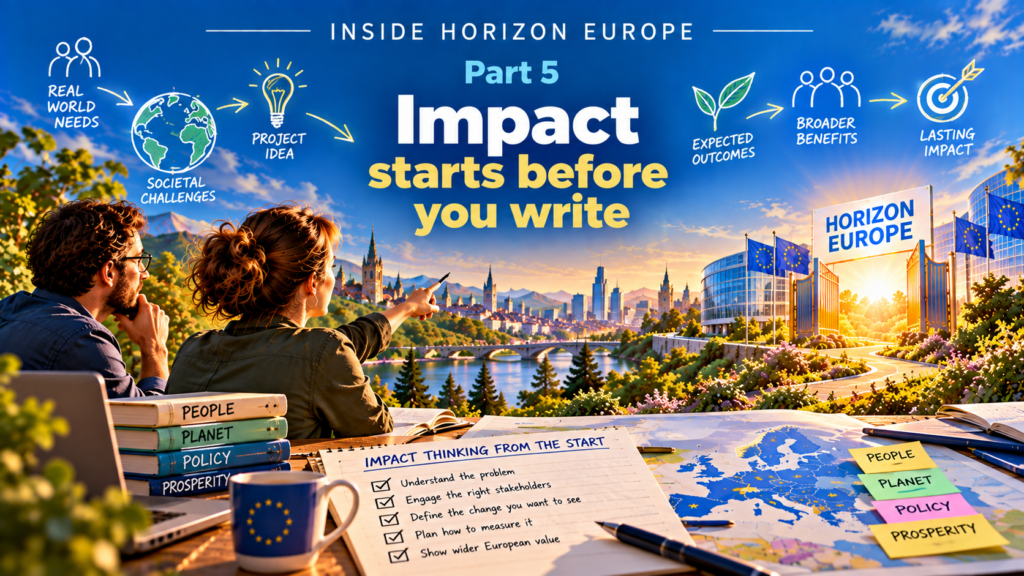
In Horizon Europe, impact isn’t something you add in once the research is designed. The strongest proposals think about who will benefit, what needs to change and how that change will happen — from the very beginning, and not as a last minute after thought. Over the last few weeks, I’ve explored why great ideas don’t always get funded, why consortium design matters, how organisations should decide whether to coordinate or join a research programme, and what Horizon Europe evaluators really mean by Excellence.
Now I want to tackle one of the areas where many strong proposals fall short, and find they do not get funded – the Impact section.
Myth 1 : “Impact is the section we write at the end of the proposal.”
This is one of the biggest mistakes applicants make.
By the time you reach the Impact section, many of the most important strategic decisions should already have been made.
Impact should shape the project from the very beginning.
It should influence:
 The objectives you set.
The partners you bring together.
The stakeholders you engage.
The activities you design.
The pathways through which results will be adopted, exploited and sustained.
A proposal does not create impact simply because it contains a well-written impact section.
It creates impact because the project has been designed from the outset with a clear understanding of who needs the outcomes, why they matter and how they will be used.
Myth 2 : “Impact means explaining how great our research is.”
Research excellence is essential.
But Horizon Europe is not only asking:
“What will you discover?”
It is also asking:
“What difference will those discoveries make?”
Evaluators want to understand:
Who are the users, beneficiaries or communities that will benefit?
What changes because of this project?
How will results move beyond the consortium?
What mechanisms will support adoption, exploitation or uptake?
What happens after the funding ends?
The strongest proposals create a convincing pathway from:
Research → Results → Uptake → Impact
Impact is not just commercialisation
Another common misconception is that impact only means creating a product, launching a company or generating economic value.
Commercial impact can be important, but Horizon Europe recognises many different forms of impact.
Depending on the project, impact may include:
- Improved public policy.
- Better healthcare outcomes.
- Environmental benefits.
- Industrial competitiveness.
- New services or technologies.
- Skills development.
- Behavioural change.
- Improved understanding of societal challenges.
The key question is not:
“Can we commercialise this?” The key question is:
“Who will use, benefit from or build upon the knowledge and outputs created by this project?”
A lesson from experience
Throughout my career supporting research commercialisation, managing large-scale research portfolios and supporting more than 500 collaborative funding applications, one pattern has become very clear:
The strongest impact strategies are not written at the end of the proposal process.
They emerge from early conversations between researchers, businesses, policymakers, practitioners, communities and end users.
I have seen projects become significantly stronger when consortia take time to understand the people who will ultimately use the outputs—not just those who will create them.
Sometimes the most valuable addition to a proposal is not another research partner.
It is the person or organisation who understands the route to adoption.
This links directly back to the importance of consortium design.
The right partners don’t just deliver the research.
They help make the impact possible.
Impact and European Added Value
Impact is also where European Added Value becomes particularly visible.
A successful Horizon Europe proposal demonstrates why collaboration across countries creates outcomes that would not be possible through isolated national projects.
This might be through:
- Access to unique infrastructures.
- Combining different datasets or expertise.
- Reaching diverse user communities.
- Creating solutions that address cross-border challenges.
- Building European networks that continue beyond the project.
Impact is not just about what happens during the grant.
It is about what continues because the project happened.
 Horizon Tip
Don’t ask:
“What is the impact of our project?”
Ask:
“Who needs the results of our project, and what will they do differently because we succeeded?”
That question should shape your proposal from the very beginning.
 What are your thoughts?
What is the biggest challenge you see when trying to demonstrate impact in research and innovation projects?
Is it identifying the right users, measuring outcomes, planning exploitation—or something else?
 Share your experiences below.