
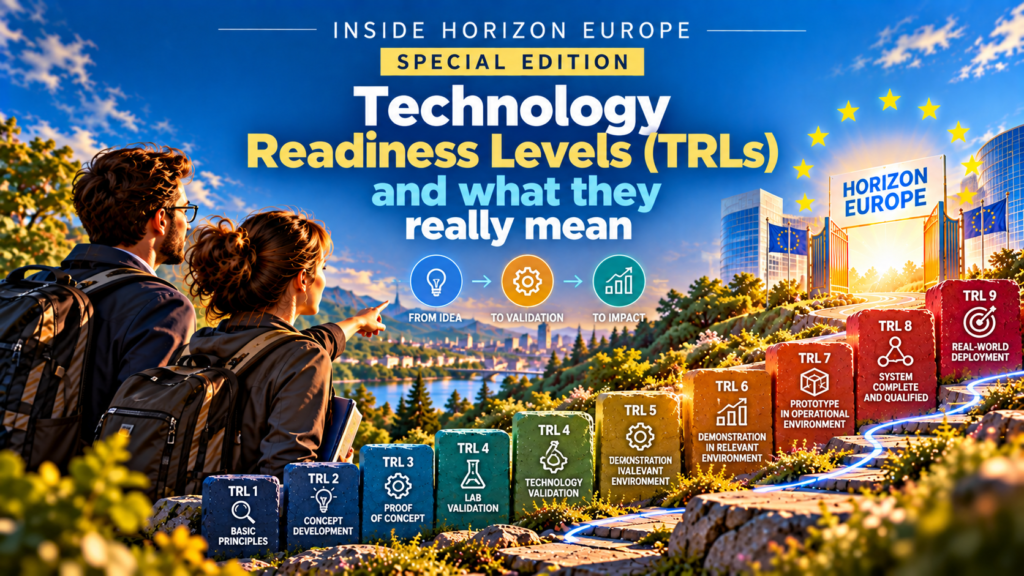
A higher TRL doesn’t automatically mean a better innovation or service. Understanding where your technology or service idea sits on the readiness scale — and what funders expect at each stage — can make all the difference to your funding strategy. In Part 4 of my Inside Horizon Europe series, I explored what “Excellence” really means to Horizon Europe evaluators. One of the key points was that excellent ideas also need to be credible, deliverable and appropriately positioned. This is where Technology Readiness Levels (TRLs) (or Service Readiness Levels (SRLs)) become so important.
Myth: “A higher TRL automatically means a better innovation.”
Not necessarily.
Technology Readiness Levels are not a simple measure of whether one innovation is better than another.
They are a way of describing the maturity of a technology—from early-stage research and scientific principles through to demonstration, deployment and market adoption.
The important question is not:
“What is the highest TRL we can claim?”
The important question is:
“Is our starting point credible, and does our proposed pathway demonstrate realistic progress?”
Understanding the TRL journey
At the early stages, projects may focus on exploring scientific principles, developing new knowledge or validating concepts.
At later stages, the focus shifts towards demonstration, testing in relevant environments, scaling, integration and adoption.
A simplified view:
TRL 1–3: Research and proof of concept
- Exploring fundamental principles.
- Developing and validating early concepts.
- Establishing technical feasibility.
TRL 4–6: Validation and demonstration
- Testing components and systems.
- Demonstrating performance in relevant environments.
- Addressing technical challenges and integration.
TRL 7–9: Deployment and adoption
- Demonstrating systems in operational environments.
- Moving towards commercialisation or widespread implementation.
- Supporting market or societal uptake.
The challenge is that not every project should—or can—move through all these stages.
A strong Horizon Europe proposal understands where the innovation starts, what progress is realistic within the project timeframe and what evidence will demonstrate that progress.
Myth: “We can increase our TRL to make our proposal more competitive.”
This is a common trap.
Overstating maturity can actually weaken a proposal.
Experienced evaluators quickly recognise when a claimed TRL doesn’t match the evidence.
For example:
A technology may have been successfully demonstrated in a laboratory environment, but that does not necessarily mean it is ready for operational deployment.
Similarly, a prototype does not automatically mean a market-ready solution.
Credibility matters.
A realistic TRL assessment, combined with a clear development pathway, is far more persuasive than an ambitious but unsupported claim.
TRLs are not just a technical issue
One of the biggest misconceptions is that TRLs are only relevant to engineers or technology developers.
They influence the whole proposal.
TRL maturity affects:
 The choice of partners needed.
The work packages and milestones.
The validation approach.
Risk management.
User engagement.
Exploitation and commercialisation plans.
The credibility of the impact pathway.
For example, moving a technology from TRL 4 to TRL 6 requires different expertise, infrastructure and partnerships than moving from TRL 7 towards deployment.
The consortium must match the ambition.
A lesson from experience
In my work supporting research commercialisation and innovation funding, one of the most important conversations is often not “Is this technology exciting?”
It is:
“What evidence do we need to generate to convince someone outside the project that this solution is ready for the next stage?”
That shift in thinking—from describing potential to demonstrating progression—is often what separates a promising idea from a credible innovation proposal.
 Horizon Tip
Don’t ask:
“How can we make our TRL look higher?”
Ask:
“What evidence will convince an evaluator that our innovation is ready for the next stage?”
 What are your thoughts?
Have you found TRLs helpful in shaping your innovation journey—or do you think they sometimes oversimplify complex research and development pathways?
 Share your experiences below.