
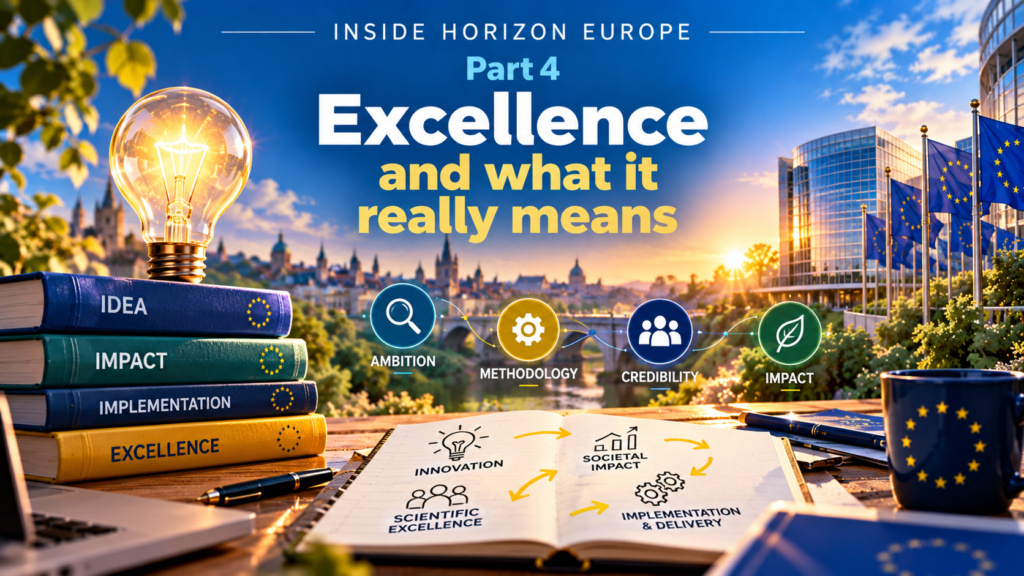
Previously, I’ve explored why great ideas don’t always get funded, the importance of building the right consortium and how to decide whether your organisation should coordinate or join a project.
This time, I’d like to challenge another common misconception.
Myth: “Excellence is simply about having great science or innovative technology.”
Not quite.
Of course, Horizon Europe is built on excellent research and innovation. Without it, a proposal is unlikely to be competitive.
But after supporting more than 500 collaborative funding applications, working with researchers, universities, SMEs and international consortia, and managing large-scale research portfolios, one lesson stands out:
Excellence is essential, but excellence alone is rarely enough.
Evaluators aren’t just asking:
“Is this a good idea?”
They’re asking:
“Is this the right idea, delivered by the right consortium, using the right approach, at the right time—and will it genuinely advance the state of the art?”
That’s a much higher bar.
True excellence is about far more than novelty.
It means demonstrating that your project is:
✔️ Ambitious enough to make a meaningful contribution to the field.
✔️ Credible, with a methodology that is robust, realistic and achievable.
✔️ Innovative, showing a genuine step beyond the current state of the art rather than simply building on existing knowledge.
✔️ Interdisciplinary, where bringing together different disciplines strengthens the research and its outcomes.
✔️ Grounded in evidence, with a clear understanding of the current landscape, competing approaches and knowledge gaps.
One of the most common weaknesses I see is proposals that spend considerable time describing how exciting the idea is, but much less time explaining how it will actually be delivered.
Innovation without credibility rarely convinces evaluators.
A lesson from experience
I once supported a consortium with a genuinely exciting concept. The innovation was clear, the scientific expertise was exceptional and the partners were highly respected.
However, as we worked through the proposal, it became clear that several important assumptions sat between the idea and the intended outcomes. Some technical risks had not been fully explored, and the pathway from research concept to practical impact needed strengthening.
By challenging those assumptions early, refining the methodology, strengthening the work packages and introducing additional validation activities, we improved the credibility of the proposal significantly.
The core idea didn’t change.
What changed was the confidence that the consortium could successfully deliver it.
That’s often what excellence looks like from an evaluator’s perspective.
It’s not about making a proposal sound more ambitious.
It’s about making ambitious ideas believable.
Excellence is also about maturity
For many innovation-focused Horizon Europe calls, evaluators will also consider whether the project is at the appropriate Technology Readiness Level (TRL) and whether there is a realistic pathway for progression during the lifetime of the project.
A proposal that promises to move from an early-stage concept to full commercial deployment within a single project is unlikely to appear credible.
Conversely, a well-designed project that clearly demonstrates how it will progress through the appropriate TRLs, supported by the right partners, resources and validation activities, gives evaluators confidence.
Understanding where your innovation sits today—and where it can realistically reach by the end of the project—is a critical part of demonstrating Excellence. I will explore this topic in more detail in a future special edition of Inside Horizon Europe.
Technology Readiness Levels – What They Really Mean in Horizon Europe
Excellent proposals also recognise that research and innovation don’t happen in isolation.
Where relevant, they demonstrate meaningful stakeholder engagement, consider the gender dimension in research and innovation, embrace open science principles and show a clear understanding of how project outputs will create value beyond academia.
These are not simply boxes to tick.
They strengthen the quality, credibility and relevance of the proposal as a whole.
Ultimately, Horizon Europe doesn’t fund ideas because they are interesting.
It funds projects because they combine:
Excellence + Impact + Implementation
into a coherent and convincing story.
💡 Horizon Tip
Don’t ask:
“How innovative is our idea?”
Ask:
“Have we convinced an evaluator that we can successfully deliver it?” Those are two very different questions.
💬 What is your perspective?
In your experience, what distinguishes an excellent Horizon Europe proposal from one that is simply good?
I’d be interested to hear your thoughts in the comments.